Loading the 3D coin…
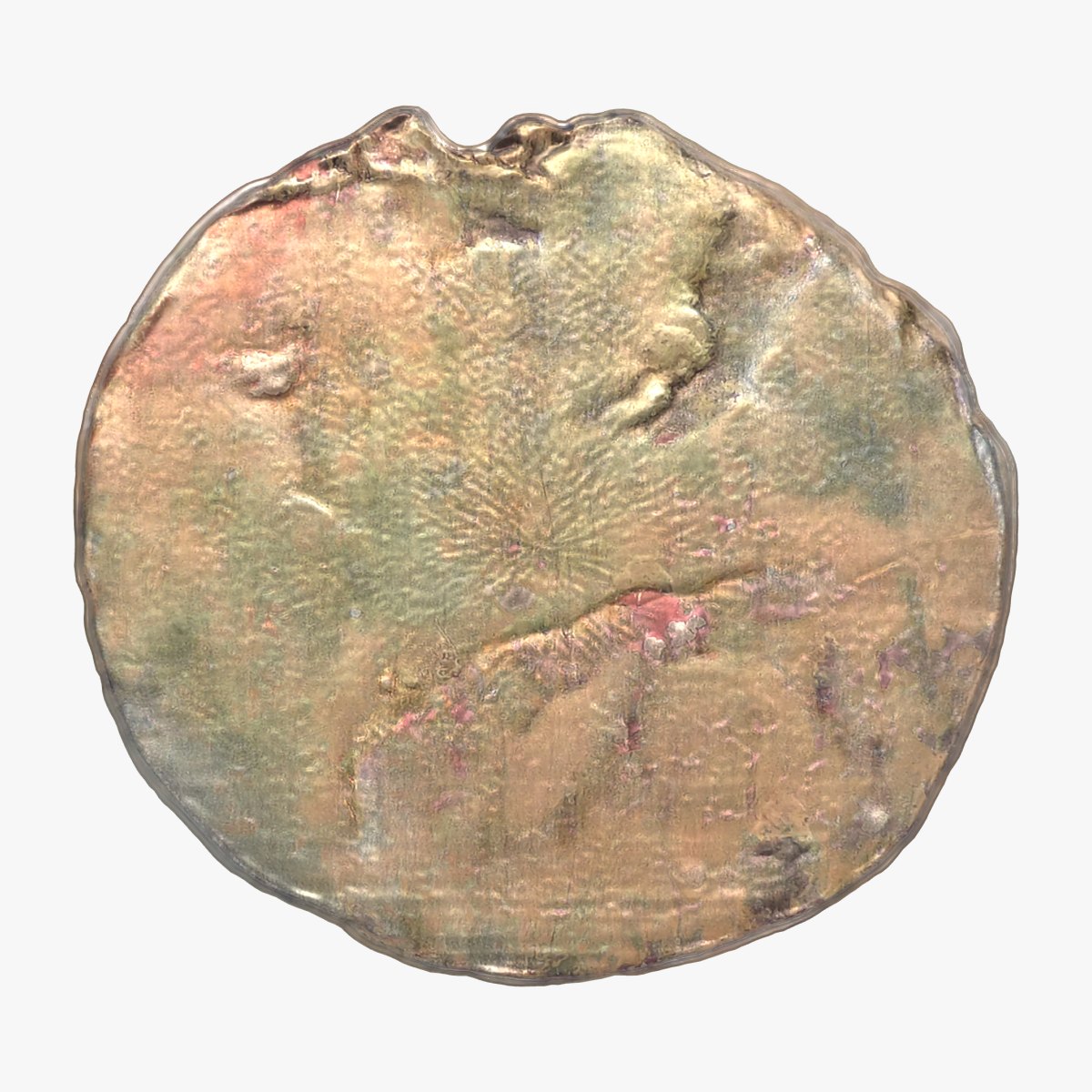
Found coin PAS 832758 i · CC BY 2.0 · Photo Adam Daubney / Lincolnshire County Council The coin shown is the Riseholme hoard's ABC 1851 stater, 5.51 g. It is copper-coloured with green spots: we take it to be a red gold rich in copper rather than a plated copy, because it has the full weight of the gold coins; the hoard record warns that gold and plated staters are hard to tell apart under the patina.
Vepo Gold Stater ‘Vepo Vep’
Date AD 20–50
Struck in Lincolnshire
Cataloguei ABC 1851
Details Design Examples References Ruler Value (members)
Details Metal Red gold, about 31% gold (estimated) Red gold : gold with much copper. The featured coin is copper-coloured with green spots; it is catalogued with the gold staters at full weight, and a dealer describes another coin of the type as rose gold. About half the recorded coins are plated copies with copper cores. No analysis of the type was found; the one analysed Corieltavian stater in Van Arsdell's table has about 31% gold and 59% copper, and Farley puts North-Eastern gold at around 35% gold.2 ,5 ,3 ,8 ,9 (estimate; no analysis of ABC 1851 found) Weight 5.51 g 5.51 g (this coin, the Riseholme hoard 's only ABC 1851). Gold coins of the type weigh 5.29–5.39 g (mean 5.34 g, 6 coins on IACB , PAS and Silbury); coins catalogued as copper alloy weigh 3.85–5.30 g, and a stripped core 1.93 g.2 ,1 ,6 ,7 ,5 ,3 (mean calculated here) Dimensions ≈ about 18.6 mm Ø diameter × by ≈ about 2.2 mm ↧ thick About 18.6 mm (this coin, measured on the photo's cm scale; 19.4 x 18.1 mm on the reverse ). Recorded coins measure 17.5–21.4 mm. This coin's thickness is not recorded; about 2.2 mm is measured on our 3D model of it, whose volume is matched to the coin's recorded weight.2 ,1 ,6 ,7 ,3 (this coin's diameter derived: measured by us on the photo's cm scale (no diameter is recorded for the hoard coins)) Date AD 20–50 AD 20–50 (IACB). PAS gives AD 10–40 for the type; the Riseholme hoard was probably buried in the first years after the Roman conquest of AD 43.1 ,3 ,2 Where struck Lincolnshire Not known exactly; the type belongs to the Corieltavi of today's Lincolnshire and the East Midlands. Recorded finds come from Lincolnshire, East Yorkshire, Warwickshire (the Bedworth hoard), Suffolk and Essex (CCI counties; Evans's coin was found at Colchester).1 ,2 ,6 ,15 ,4 Mint Not known Not known: no mint is named on the coins. A Corieltavian mint site is known at Sleaford in Lincolnshire, but these coins are not tied to it.10 (searched IACB, PAS records, Evans 1864) Dies known Not known Not known: no die study of this type was found. (searched IACB, PAS records, Evans 1864, Silbury notes) Estimated output Not known Not known: without a die count no output can be estimated. (no die count published that we could find) Known examples 13 on IACB; about 13–17 recorded 13 on IACB (1 ABC exemplar , 9 Celtic Coin Index cards, 2 British Museum coins, 1 PAS find). The Riseholme coin, two Bedworth hoard finds and a dealer's coin are not on that list, so 13–17 are recorded; the dealer counts 12 known, 6 of them plated.1 ,2 ,6 ,7 ,5 Close types Not the VEP CORF staters ABC 1851 is the only Vepo stater with a horse to the left, a triangular head and a pellet rosette ; the VEP CORF staters (ABC 1854–1863; our coin 101 is ABC 1863) have a wreath obverse and CORF below a horse with a split neck.1 ,4 Where to see one British Museum (by appointment) British Museum , London. In store, can be seen by appointment; 1 example (BMC 3274). Hobbs's 1996 catalogue of the Museum's Iron Age coins lists this type as no. 3274. Not known to be on display; the Money and Medals Study Room shows any coin in the collection by appointment. search the British Museum collection 16 ,17 Other museum examples may be listed by IACB: see IACB Checked 2026-11-04. Displays change: check with the museum before a visit.
Design Obverse front 1 Blank face (wreath worn away) Established A blank, slightly domed face with no wreath visible. IACB describes the obverse as a wreath, often obliterated1 4
Context from the period The wreath is what is left of the laurel wreath of Apollo on the gold stater of Philip II of Macedon, the distant model of British gold11 One reading A Treasure report on a Bedworth coin of this type says the wreath on the obverse is obliterated7 Reverse back 2 Triangular head with curved ears Established A triangle pointing down to the left forms the horse's head, with a pellet at its upper corner4
Established IACB calls it a large triangular head; Evans: 'the head formed by a triangle with a pellet at the apex, the ears curved forwards4 One reading Evans notes the square nose and the pellets in front link this type to an uninscribed stater (his pl. XVII.11), from which he thought it derived4 3 Pellet rosette in front Established A cluster of pellets, a rosette 1 flan .
Context from the period Evans calls it 'a star of pellets'4 4 Lunate horse body Established Three bold crescents to the right of the head make the horse's body and legs: a lunate horse 1
Context from the period The crescent-built horse is the last stage of the chariot horse of Philip II's stater11 5 Legend VE(P) Established The letters VEP stand above the horse at the upper right; V and E are joined4
Established VEP is the start of the name Vepo, written VEPO on silver and with CORF on other gold staters1 One reading Evans thought the inscription would 'if complete, have proved to be VEP CORF4 6 Pellets below One reading Small pellets low on the left, below the head, where IACB records a star1
Die-by-die notes on each feature Members
Examples 16 catalogued
11 shown
5 linked
13 known in all1 ,2 ,6 ,7 ,5
Featured PAS 832758 5.51 g · 18.6 mm Photo: Adam Daubney / Lincolnshire County Council / The Portable Antiquities Scheme, via Wikimedia Commons CC BY 2.0 For members PAS 736598 1.93 g · 17.7 mm Photo: Martin Foreman / North Lincolnshire Museum / The Portable Antiquities Scheme, via Wikimedia Commons CC BY 2.0 CCI 03.1371 Photo: Celtic Coin Index (Institute of Archaeology, Oxford) / PAS, via Wikimedia Commons CC BY-SA 4.0 · crop shared under the same licenceCCI 63.0147 3.85 g Photo: Celtic Coin Index (Institute of Archaeology, Oxford) / PAS, via Wikimedia Commons CC BY-SA 2.0 · crop shared under the same licenceCCI 63.0148 4.25 g Photo: Celtic Coin Index (Institute of Archaeology, Oxford) / PAS, via Wikimedia Commons CC BY-SA 2.0 · crop shared under the same licenceCCI 79.0006 5.3 g Photo: Celtic Coin Index (Institute of Archaeology, Oxford) / PAS, via Wikimedia Commons CC BY-SA 4.0 · crop shared under the same licenceCCI 84.0092 3.88 g Photo: Celtic Coin Index (Institute of Archaeology, Oxford) / PAS, via Wikimedia Commons CC BY-SA 2.0 · crop shared under the same licenceCCI 90.0808 5.33 g Photo: Celtic Coin Index (Institute of Archaeology, Oxford) / PAS, via Wikimedia Commons CC BY-SA 2.0 · crop shared under the same licenceCCI 92.0175 4.88 g Photo: Celtic Coin Index (Institute of Archaeology, Oxford) / PAS, via Wikimedia Commons CC BY-SA 4.0 · crop shared under the same licenceCCI 93.0829 5.37 g Photo: Celtic Coin Index (Institute of Archaeology, Oxford) / PAS, via Wikimedia Commons CC BY-SA 2.0 · crop shared under the same licenceCCI 97.2336 5.3 g Photo: Celtic Coin Index (Institute of Archaeology, Oxford) / PAS, via Wikimedia Commons CC BY-SA 4.0 · crop shared under the same licenceFree: the featured coin. Members: the other openly licensed photos.
See every photo full size, and which examples share a die Members
Linked examples
References Evans 1864, plate XVII, fig. 7, p. 413 Public-domain book · Same type Plate XVII., No. 7.
Obv.—Plain and convex.
Rev.—VEP. Rude horse to the left, the head formed by a triangle with a pellet at the apex, the ears curved forwards; in front of the head a star of pellets, below it two other pellets. Æ.
This coin was formerly in the collection of Dr. Duncan, of Colchester, and was found at that place. A woodcut of it is given in the Arch. Assoc. Journ., vol. ii. p. 190, but the coin is there assigned to Verulamium. There can, however, be no doubt, from the character of the horse, the module, and the inscription, that it belongs to the same class as the preceding coins, notwithstanding its having been found so far south as Colchester. I find also, from a note I made when I examined Dr. Duncan's collection, in 1859, that I considered the metal to be base gold rather than brass. Evans 1864, plate XVII, fig. 7, p. 413 · Read it on p. 413 Whole book at the Internet Archive
Catalogues and books ABC 1851 E. Cottam, P. de Jersey, C. Rudd and J. Sills, Ancient British Coins (Aylsham 2010), no. 1851 ('Vepo Vep') E. Cottam, P. de Jersey, C. Rudd and J. Sills , Ancient British Coins (Aylsham 2010), no. 1851 ('Vepo Vep') · link
VA 905 R. D. Van Arsdell, Celtic Coinage of Britain (London 1989), no. 905 R. D. Van Arsdell, Celtic Coinage of Britain (London 1989), no. 905
BMC 3274 R. Hobbs, British Iron Age Coins in the British Museum (London 1996), no. 3274 R. Hobbs, British Iron Age Coins in the British Museum (London 1996), no. 3274
Sources 1 IACB ABC 1851Iron Age Coins in Britain (IACB), University of Oxford: type ABC 1851 (Vepo; Corieltavi; gold stater; AD 20–50; obv. 'Wreath (often obliterated)'; rev. 'Lunate horse left, large triangular head, pellet rosette in front, VEP above, star below') and its examples list (13 records: ABC exemplar, 9 Celtic Coin Index, 2 British Museum, 1 PAS; CSV read 4 Nov 2026) Iron Age Coins in Britain (IACB), University of Oxford: type ABC 1851 (Vepo; Corieltavi; gold stater; AD 20–50; obv. 'Wreath (often obliterated)'; rev. 'Lunate horse left, large triangular head, pellet rosette in front, VEP above, star below') and its examples list (13 records: ABC exemplar, 9 Celtic Coin Index, 2 British Museum, 1 PAS; CSV read 4 Nov 2026) link
2 PAS 832758 (Riseholme hoard)Portable Antiquities Scheme record 832758 (LIN-EB6C54), Riseholme, Lincolnshire: hoard of 282 Corieltavian coins (40 gold staters, 231 silver units, 11 silver half units); catalogue by ABC number with weights, '1851 VEP CORF; 5.51'; 'owing to patina it is often unclear whether a stater is gold or plated'; photo A. Daubney / Lincolnshire County Council, CC BY 2.0 (featured coin; Commons copy) Portable Antiquities Scheme record 832758 (LIN-EB6C54), Riseholme, Lincolnshire: hoard of 282 Corieltavian coins (40 gold staters, 231 silver units, 11 silver half units); catalogue by ABC number with weights, '1851 VEP CORF; 5.51'; 'owing to patina it is often unclear whether a stater is gold or plated'; photo A. Daubney / Lincolnshire County Council, CC BY 2.0 (featured coin; Commons copy) link
3 PAS 736598Portable Antiquities Scheme record 736598, North Lincolnshire: base-metal core 'possibly from a plated gold inscribed stater ... ABC no. 1851, Van Arsdell no. 905-2'; 'About half the versions of this rare coin reported are plated'; 17.7 mm, 1.93 g; photo M. Foreman / North Lincolnshire Museum, CC BY 2.0 (Commons copy) Portable Antiquities Scheme record 736598, North Lincolnshire: base-metal core 'possibly from a plated gold inscribed stater ... ABC no. 1851, Van Arsdell no. 905-2'; 'About half the versions of this rare coin reported are plated'; 17.7 mm, 1.93 g; photo M. Foreman / North Lincolnshire Museum, CC BY 2.0 (Commons copy) link
4 Evans 1864J. Evans, The Coins of the Ancient Britons (London 1864), pl. XVII no. 7, p. 413 (and pl. XVII.11, pp. 412–415) J. Evans, The Coins of the Ancient Britons (London 1864), pl. XVII no. 7, p. 413 (and pl. XVII.11, pp. 412–415) link
5 Silbury Coins IAC324Silbury Coins, fixed-price listing IAC324: Vepo gold stater, ABC 1851, 20 mm, 5.39 g, 'rose gold'; '12 known, 6 of which are plated'; cites Evans XVII.7; London Collection (in stock, read 4 Nov 2026) Silbury Coins, fixed-price listing IAC324: Vepo gold stater, ABC 1851, 20 mm, 5.39 g, 'rose gold'; '12 known, 6 of which are plated'; cites Evans XVII.7; London Collection (in stock, read 4 Nov 2026) link
6 PAS 436563 (Bedworth addenda 2011)Portable Antiquities Scheme record 436563, Warwickshire: three gold coins found in 2011, addenda to the Bedworth hoard of 1994; 'VEP CORF stater, ABC 1851 / VA 905 / BMC 3274 Diameter: 21.4mm; weight: 5.33'; the 1994 hoard's eleven staters were acquired by Warwickshire Museum Service (Commons copy, CC BY-SA 2.0) Portable Antiquities Scheme record 436563, Warwickshire: three gold coins found in 2011, addenda to the Bedworth hoard of 1994; 'VEP CORF stater, ABC 1851 / VA 905 / BMC 3274 Diameter: 21.4mm; weight: 5.33'; the 1994 hoard's eleven staters were acquired by Warwickshire Museum Service (Commons copy, CC BY-SA 2.0) link
7 PAS 532753 (Bedworth, 2012 T857)Portable Antiquities Scheme record 532753, Warwickshire: Treasure 2012 T857, Bedworth hoard second addenda; 'North Eastern stater inscribed VEP, ABC 1851 / VA 905 / BMC 3274 (wreath on obverse obliterated). Diameter: 20mm; weight: 5.29g' (Commons copy, CC BY-SA 2.0) Portable Antiquities Scheme record 532753, Warwickshire: Treasure 2012 T857, Bedworth hoard second addenda; 'North Eastern stater inscribed VEP, ABC 1851 / VA 905 / BMC 3274 (wreath on obverse obliterated). Diameter: 20mm; weight: 5.29g' (Commons copy, CC BY-SA 2.0) link
8 Van Arsdell 1989, metallurgy tableR. D. Van Arsdell, Celtic Coinage of Britain (1989), metallurgy table: VA 978-1, an inscribed Corieltavian stater, Au 31.46, Ag 9.39, Cu 59.09 (Northover), as read for coin 48 of this site R. D. Van Arsdell, Celtic Coinage of Britain (1989), metallurgy table: VA 978-1, an inscribed Corieltavian stater, Au 31.46, Ag 9.39, Cu 59.09 (Northover), as read for coin 48 of this site link
9 Farley 2012J. Farley, 'At the Edge of Empire: Iron Age and Early Roman Metalwork in the East Midlands', PhD thesis, University of Leicester (2012), section 2.2: North-Eastern gold of around 35% gold J. Farley, 'At the Edge of Empire: Iron Age and Early Roman Metalwork in the East Midlands', PhD thesis, University of Leicester (2012), section 2.2: North-Eastern gold of around 35% gold link
10 Wikipedia: CorieltauviWikipedia, 'Corieltauvi' (read 4 Nov 2026): a people of today's East Midlands, capital Ratae (Leicester), inscribed coins with paired names Wikipedia, 'Corieltauvi' (read 4 Nov 2026): a people of today's East Midlands, capital Ratae (Leicester), inscribed coins with paired names link
11 Wikipedia: Celtic coinageWikipedia, 'Celtic coinage' (read 4 Nov 2026): Celtic gold copied the Macedonian stater of Philip II, head of Apollo and two-horse chariot Wikipedia, 'Celtic coinage' (read 4 Nov 2026): Celtic gold copied the Macedonian stater of Philip II, head of Apollo and two-horse chariot link
12 ABC 1851E. Cottam, P. de Jersey, C. Rudd and J. Sills, Ancient British Coins (Aylsham 2010), no. 1851 (cited through IACB, PAS and Silbury Coins) E. Cottam, P. de Jersey, C. Rudd and J. Sills, Ancient British Coins (Aylsham 2010), no. 1851 (cited through IACB, PAS and Silbury Coins) link
13 VA 905R. D. Van Arsdell, Celtic Coinage of Britain (London 1989), no. 905 (905-2 for PAS 736598), cited by PAS R. D. Van Arsdell, Celtic Coinage of Britain (London 1989), no. 905 (905-2 for PAS 736598), cited by PAS
14 BMC 3274R. Hobbs, British Iron Age Coins in the British Museum (London 1996), no. 3274, cited by PAS 436563 and 532753 R. Hobbs, British Iron Age Coins in the British Museum (London 1996), no. 3274, cited by PAS 436563 and 532753
15 CCI cards on CommonsCeltic Coin Index cards 03.1371, 63.0147, 63.0148, 79.0006, 84.0092, 90.0808, 92.0175, 93.0829 and 97.2336 (the nine IACB lists under ABC 1851), copied into PAS and onto Wikimedia Commons (CC BY-SA); five catalogued as copper alloy, four as gold Celtic Coin Index cards 03.1371, 63.0147, 63.0148, 79.0006, 84.0092, 90.0808, 92.0175, 93.0829 and 97.2336 (the nine IACB lists under ABC 1851), copied into PAS and onto Wikimedia Commons (CC BY-SA); five catalogued as copper alloy, four as gold link
16 Hobbs 1996R. Hobbs, British Iron Age Coins in the British Museum (London 1996): the British Museum's own coins, by catalogue number (BMC) R. Hobbs, British Iron Age Coins in the British Museum (London 1996): the British Museum's own coins, by catalogue number (BMC)
17 Wikipedia: BM Money and MedalsWikipedia, 'British Museum Department of Money and Medals' (read 29 Oct 2026): 'Items from the full collection can be seen by the general public in the Study Room by appointment.' Wikipedia, 'British Museum Department of Money and Medals' (read 29 Oct 2026): 'Items from the full collection can be seen by the general public in the Study Room by appointment.' link
Ruler Vepo · c. AD 20–50
Corieltavian issuer known only from coins inscribed VEP
Vepo is a name known only from coins of the Corieltavi of today's Lincolnshire and the East Midlands, struck in the decades before the Roman conquest. It appears as VEP on this stater , as VEPO on silver, and with CORF on most gold staters (VEP CORF); nothing is known of the person behind it. VEP CORF coins make up about a third of the gold in the Riseholme hoard near Lincoln.1 ,2 ,10
Known for One of the commonest named issuers of the Corieltavi, in gold and silver.
People Corieltavi : A people of today's East Midlands (Lincolnshire, Leicestershire, Nottinghamshire and neighbouring counties), with their later Roman capital at Leicester; their late coins name individuals or pairs of people.10 ,1
Read more: Iron Age Coins in Britain: ABC 1851 · Wikipedia: Corieltauvi · Vepo: all coins · Corieltavi: all coins
Value Members Last sale £5,500 asking (in stock) · Silbury Coins fixed-price listing IAC324, 2026-09
Other recorded sales (£5,500 to £5,500), each with its source One dealer asking price (in stock). ← Previous coin · Next coin → · Sources · Terms · Privacy